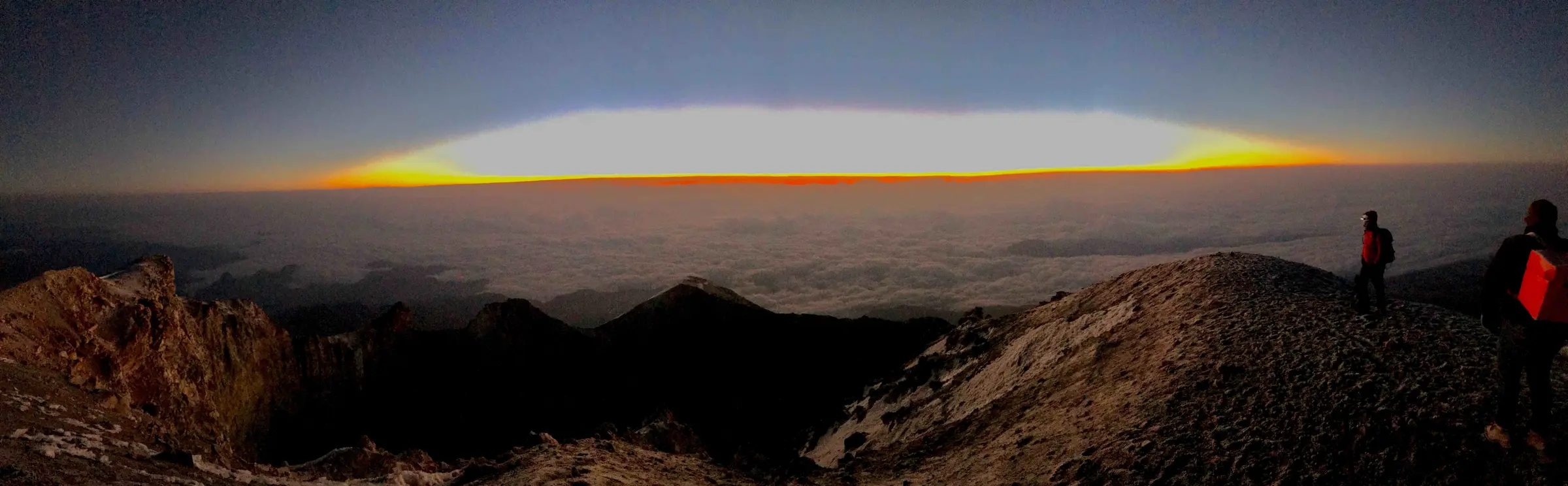
Sunrise panorama from the summit of Pico de Orizaba, the highest mountain in Mexico.
Research and publications
Generally, I am interested in algebraic number theory and arithmetic geometry.
Here is a talk I gave at the Charles University Number Theory Seminar about my thesis work.
It includes a good deal of background.
A current motivation of my research is understanding the relationship between monogenicity and other arithmetic properties of number fields.
It appears that 'monogeneity' is more commonly used to indicate "the quality of being monogenic" in mathematics.
However, in other fields, 'monogeneity' indicates "the quality of being monogeneous," while 'monogenicity' refers to
"the quality of being monogenic." Some sources in mathematics refer to number fields as 'monogeneous,' rather than 'monogenic.'
(We note that at least one paper refers to 'monogenesis,' which is often used to indicate
"the theory that all humankind originated with a single ancestor or ancestral couple."
For the sake of brevity, but at the expense of allegory, we will not delve deeper into this possible terminology here.)
The author has chosen to use 'monogeneity' simply because it returns more relevant results on
MATHSCINET.
Though, in an effort to find some solice, the author decided to investigate the etymology.
According to Wikitionary, which proved a much more satisfactory resource
than many more well-established dictionaries, 'monogeneous' and 'monogenic' are derived from the Ancient Greek words
μόνος (mόnos), meaning "alone," "only," "sole," or "single," and γενής (genḗs), meaning "offspring" or "kind."
(The interested reader should note that multiple diacritics, e.g. 'ḗ,'
on one character is a difficult feat to achieve in LaTeX. The package covington yields a solution that the author finds adequate;
however, linguists may want to delve deeper down the
StackExchange rabbit hole.)
Thus the difference lies in the suffixes '-ic' and '-ous.' The origin of '-ic' is the Latin '-icus,'
meaning "belonging to" or "derived from." Conversely, '-ous' is derived from the Latin '-ōsus,'
indicating "full," or "full of." The modern usages of '-ic' and '-ous' are more similar,
but retain a connotation coming from their Latin roots. As such, 'monogenic' seems the more appropriate term to
describe the number fields we will study. Frustratingly, it appears 'monogenicity' should be the more canonical
way to turn our preferred adjective into a noun.
It may also be worthwhile to note that both 'monogeneous' and 'monogenic' include mathematical definitions in their
Wiktionary entries and neither definition is at all related to our current study.
This paper gives a construction of radical extensions with arbitrarily large minimal index.
For a number field K/Q, the minimal index is the least positive integer m for which there exists a monogenic order with index m in the maximal order.
For any n>2 and N>1, we construct infinitely many number fields of degree n with minimal index greater than N.
This paper with master's student Dylan Scofield classifies the splitting of 2 in radical extensions.
With previous work for odd primes, we fully classify common N-index divisors in radical extensions.
To highlight this, we construct novel examples of non-monogenic extensions both with and without common index divisors.
Following work of Vélez, we explicitly describe the splitting of the integral prime 2 in the radical extension
Q(a1/n), where xn - a is an irreducible polynomial in Z[x].
With previous work of the second author, this fully describes the splitting of any prime in Q(a1/n).
Using this description, we classify common index divisors (the primes whose splitting prevents the existence of a power integral basis for the ring of integers).
Using work of Pleasants, we extend this to describe common N-index divisors (primes that divide the index of any order generated over Z by N elements).
We also present two novel constructions of non-monogenic fields with no common index divisors as well as constructions of number rings requiring N ring generators for any N.
Examples are provided throughout.
This is a paper with my colleagues Wayne Aitken and Kimberly Ayers.
We present a cohesive framework for extending single-variable Boyd–Lawton theorems to multivariable settings.
The classical Boyd–Lawton theorem concerning Mahler measures has recently been extended to multivariable limits by Brunault, Guilloux, Mehrabdollahei, and Pengo.
In another direction, the single-variable Boyd–Lawton theorem has been generalized to various extensions of Mahler measure by Issa and Lalín.
The goal of this paper is to present a cohesive framework for extending single-variable Boyd–Lawton theorems to multivariable Boyd–Lawton theorems.
With this, we broaden the single-variable Boyd–Lawton theorems of Issa and Lalín to multivariable versions in the direction of
Brunault, Guilloux, Mehrabdollahei, and Pengo, providing a generalization of both works.
This is a paper with Joachim König and Zack Wolske that gives necessary and sufficient conditions for the monogenicity
of the iterates of a polynomial (dynamical monogenicity) in terms of the critical points.
Let K be a number field with ring of integers OK, and let f(x)∈OK[x] be a monic, irreducible polynomial.
We establish necessary and sufficient conditions in terms of the critical points of f(x) for the iterates of f(x) to be monogenic polynomials.
More generally, we give necessary and sufficient conditions for the backwards orbits of elements of OK under f(x) to be monogenerators.
We apply our criteria to construct novel examples of dynamically monogenic polynomials,
yielding infinite towers of monogenic number fields with the backward orbit of one monogenerator giving a monogenerator at the next level.
This paper classifies the odd prime splitting and common index divisors in radical extensions.
We explicitly describe the splitting of odd integral primes in the radical extension Q(a1/n),
where xn - a is an irreducible polynomial in Z[x].
Our motivation is to classify common index divisors,
the primes whose splitting prevents the existence of a power integral basis for the ring of integers of Q(a1/n).
Among other results, we show that if p is such a prime, even or otherwise, then p divides n.
This is a paper I wrote with Zack Wolske that gives necessary and sufficient conditions for the dynamical monogenicity of a quadratic polynomial.
[
| Accepted to the Rocky Mountain Journal of Mathematics
|arXiv: 2406.03629 ]
We investigate monogenicity and prime splitting in extensions generated by roots of iterated quadratic polynomials.
Let f(x)∈Z[x] be an irreducible, monic, quadratic polynomial, and write fn(x) for the nth iterate.
We obtain necessary and sufficient conditions for fn(x) to be monogenic for each n.
We use this to construct multiple families where fn(x) is monogenic for every n>0.
This paper extends a result of Ruofan Li on the monogenicity of iterated quadratic radical polynomials to radical polynomials of any prime degree.
Let a be an integer and p a prime so that f(x) = xp-a is irreducible.
Write fn(x) to indicate the n-fold composition of f(x) with itself.
We study the monogenicity of number fields defined by roots of fn(x) and
give necessary and sufficient conditions for a root of fn(x) to yield a power integral basis for each n≥1.
This paper uses a new representation of the Frobenius endomorphism to investigate the
monogeneity of division fields of abelian varieties of dim > 1.
Let A be an abelian variety over a finite field k with |k| = q = pm. Let π ∈ Endk(A) denote the Frobenius and let v = q/π denote Verschiebung.
Suppose the Weil q-polynomial of A is irreducible.
When Endk(A) = Z[π,v], we construct a matrix which describes the action of π on the prime-to-p-torsion points of A.
We employ this matrix in an algorithm that detects when p is an obstruction to the monogeneity of division fields of certain abelian varieties.
Here are two papers that I wrote with my friends Sarah Arpin, Sebastian Bozlee,
and Leo Herr recasting monogenicity in a more geometric way.
This is the first in a series of two papers that study monogenicity of number rings from a moduli-theoretic perspective.
Given an extension of algebras B/A, when is B generated by a single element θ∈B over A?
In this paper, we show there is a scheme MB/A parameterizing the choice of a generator θ∈B, a "moduli space" of generators.
This scheme relates naturally to Hilbert schemes and configuration spaces. We give explicit equations and ample examples.
This is the sequel paper to The Scheme of Monogenic Generators I. It continues a study of monogenicity of number rings from a moduli-theoretic perspective.
By the results of the first paper in this series, a choice of a generator θ for an A-algebra B is a point of the scheme MB/A.
In this paper, we study and relate several notions of local monogenicity that emerge from this perspective.
We first consider the conditions under which the extension B/A admits monogenerators locally in the Zariski and finer topologies,
recovering a theorem of Pleasants as a special case. We next consider the case in which B/A is étale,
where the local structure of étale maps allows us to construct a universal monogenicity space and relate it to an unordered configuration space.
Finally, we consider when B/A admits local monogenerators that differ only by the action of some group (usually Gm or Aff1),
giving rise to a notion of twisted monogenerators. In particular, we show a number ring A has class number one if and only if
each twisted monogenerator is in fact a global monogenerator θ.
Here is a paper investigating the monogeneity and non-monogeneity of division fields of elliptic curves.
For various positive integers n, we show the existence of infinite families of elliptic
curves over ℚ with n-division fields, ℚ(E[n]), that are not monogenic, i.e., the ring of integers does
not admit a power integral basis. We parametrize some of these families explicitly. Moreover, we
show that every E/ℚ without CM has infinitely many non-monogenic division fields. Our main
technique combines a global description of the Frobenius obtained by Duke and Tóth with a simple
algorithm based on ideas of Dedekind.
Here
is a video introducing this work that I recorded for the Junior Mathematician Research Archive.
Here is a paper I wrote with Mark van Hoeij investigating
divisors of modular units and bounding the ℚ-gonality of X1(N).
We give a formula for divisors of modular units on X1(N) and use it to prove that the
ℚ-gonality of the modular curve X1(N) is bounded above by [11N2/840], where [•] denotes the nearest
integer.
Below is a paper investigating monogeneity in Kummer extensions and radical extensions.
We give necessary and sufficient conditions for the Kummer
extension K:=ℚ(ζn,α1/n) to be monogenic over ℚ(ζn) with α1/n as a generator,
i.e., for OK=ℤ[ζn][α1/n]. We generalize these ideas to radical extensions of an
arbitrary number field L and provide necessary and sufficient conditions for α1/n
to generate a power OL-basis for OL(α1/n).
We also give sufficient conditions for K to be non-monogenic over ℚ and
establish a general criterion relating ramification and relative monogeneity. Using
this criterion, we find a necessary and sufficient condition for a relative cyclotomic
extension of degree φ(n) to have ζn as a monogenic generator.
Here are my slides from a presentation about this work.
Below is the paper that came out of the REU Katherine Stange and I ran in the summer of 2018.
The REU students (Ryan Ibarra, Henry Lembeck, Mohammad Ozaslan) were excellent and we were able to generalize
some of my results on the monogeneity of quartic fields to trinomials of arbitrary degree.
We call a polynomial monogenic if a root θ has the property that ℤ[θ] is the full ring of integers in ℚ(θ).
Using the Montes algorithm, we find sufficient conditions for
xn +ax+b and xn+cxn-1+d to be monogenic (this was first studied by Jakhar, Khanduja, and Sangwan using other methods).
Weaker conditions are given for n=5 and n=6. We also show that each of the families xn+bx+b and xn+
cxn-1+cd
are monogenic infinitely often and give some positive densities in terms of the coefficients.
This is a paper that uses ramification in division fields to preclude certain supersingular elliptic curves from corresponding to sporadic points on modular curves.
Consider an elliptic curve E over a number field K. Suppose that E has supersingular
reduction at some prime p of K lying above the rational prime p and that E(K) has a point of exact
order pn. To describe the minimum necessary ramification at p, we completely classify the valuations
of the pn-torsion points of E by the valuation of a coefficient of the p-th division polynomial. In
particular, if E does not have a canonical subgroup at p, we show that p has ramification index at
least p2n-p2n-2 over p.
We apply this bound to show that sporadic points on the modular curve X1(pn) cannot correspond to
supersingular elliptic curves without a canonical subgroup. Our methods are generalized
to X1(N) with N composite.
Here are my slides from a presentation at JMM 2021 about this work.
This is a paper classifying two infinite families of monogenic S4 Quartic fields.
Consider the integral polynomials fa,b(x)=x4+ax+b and gc,d(x)=x4+cx3+d. Suppose fa,b(x) and gc,d(x) are irreducible,
b|a, and the integers b, d, 256d-27c4, and (256b3-27a4)/gcd(256b3,27a4) are all square-free. Using the Montes algorithm,
we show that a root of fa,b(x) or gc,d(x) defines a monogenic extension of Q and serves as a generator for a power integral basis
of the ring of integers. In fact, we show monogeneity for slightly more general families. Further, we obtain lower bounds on the density of polynomials
generating monogenic S4 fields within the families fb,b(x) and g1,d(x).
We consider partial torsion fields (fields generated by a root of a division polynomial) for elliptic curves. By analysing the reduction properties of
elliptic curves, and applying the Montes Algorithm, we obtain information about
the ring of integers. In particular, for the partial 3-torsion fields for a certain
one-parameter family of non-CM elliptic curves, we describe a power basis. As
a result, we show that the one-parameter family of quartic S4 fields given by
T4 − 6T2 − αT − 3 for α ϵ Z such that α ± 8 are squarefree, are monogenic.
Here are my slides from a presentation about this work.
Here is a paper I helped with while at an REU at Grand Valley State University. William Dickinson was our project advisor.
We find explicit formulas for the radii and locations of the circles in all the optimally dense packings of two,
three or four equal circles on any flat torus, defined to be the quotient of the Euclidean plane by the lattice
generated by two independent vectors.
We prove the optimality of the arrangements using techniques from rigidity theory and topological graph theory.